Using art-based techniques to develop flexible thinking under pressure
Most professionals are trained to solve problems fast. Gather facts, identify a cause, fix it, move on. And often, that works – until you’re dealing with something more complex. The kind of issue that keeps coming back, shifts shape, or never quite gets resolved. In those situations, speed becomes a trap.
The basics: stop jumping to conclusions
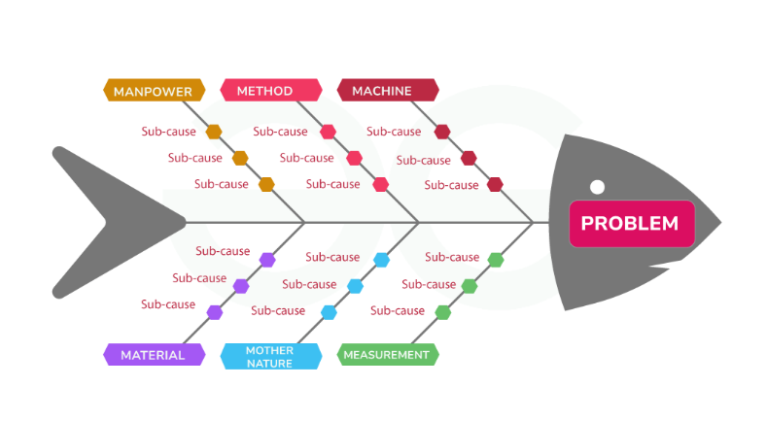
In quality management, one of the most influential tools is the Ishikawa diagram, developed by Kaoru Ishikawa in 1960s Japan. It introduced a simple but powerful idea: instead of settling on a single cause, turn root cause analysis into a short thinking game.
Take a problem and challenge yourself to identify at least five contributing factors across people, process, tools and environment. You’re not allowed to stop at one.
That shift – from linear to systemic thinking – remains highly relevant today. Yet even with structured tools, we tend to fall back into familiar reasoning patterns.
What changes when you work this way is subtle but important. You stop looking for the cause and start seeing a system. You generate options instead of jumping to conclusions. And often, the real issue only becomes visible once you’ve allowed yourself to explore beyond your first answer.
The underlying principle: play wide, decide narrow. Explore broadly, then commit with clarity.
For the ambitious: use constraints as a creative catalyst
There’s another way to stimulate flexible thinking – one borrowed from an unlikely source.
Black Mountain College was an experimental arts institution in North Carolina, and its story carries a useful irony. In its early years, the college lacked resources and had to work with what was available. What they discovered by accident was that their founding constraints – limited money, limited infrastructure – became a creative catalyst. Limitation, not freedom, unlocked originality.
The art world had been wrestling with a similar challenge for decades: how do you avoid repeating the same patterns? At places like Black Mountain, artists deliberately worked with constraints – removing elements, restricting materials – to force new ways of seeing. Constraints shifted focus from execution to intentional experimentation.
The same principle applies to thinking. When you deliberately remove a variable from your analysis, you disrupt habitual reasoning and open up new lines of inquiry.
Now: a 10-minute practice
I’ve been experimenting with a simple practice that combines both worlds — structured problem-solving and constraint-based exploration. No workshop, no long sessions. Just a pen, a blank page and a bit of discipline.
𝗦𝘁𝗲𝗽 · 𝗧𝗶𝗺𝗲 · 𝗙𝗼𝗰𝘂𝘀 · 𝗪𝗵𝗮𝘁 𝘆𝗼𝘂 𝗱𝗼
▸ Before you begin · Pick your problem · Choose one problem that’s been nagging at you.
▸ 1. Define · 2 min · Facts only · Write down what happened, when, and the measurable impact. No interpretations.
▸ 2. Map · 3 min · See the system · Sketch a cause-and-effect structure using the fishbone method: people, process, tools, environment.
▸ 3. Expand · 3 min · Break patterns · Remove one key element (e.g. process, ownership, time pressure, manpower, material) and observe what changes. Extra: reverse it: how would you cause this problem?
▸ 4. Shift · 1 min · New perspectives · What would a junior colleague, a customer, or a top performer notice that you’re missing?
▸ 5. Test · 1 min · Validate thinking · What evidence supports your assumptions? What would disprove them? No evidence = hypothesis, not fact.
▸ 6. Act · 1 min · Move forward · Select one primary and one secondary cause. Define a small action, expected result and timing.
Ten minutes. One problem. A sharper perspective.
Let me know how it goes 🙂
-

The Power of Mindful Observation
Playful inspiration from David Hockney My professor made us draw the same trees for months.…
-
What Artists Know About Root Cause Analysis That Engineers Don’t
Using art-based techniques to develop flexible thinking under pressure Most professionals are trained to solve…
-
Why Smart People Sometimes Appear Less Creative
Many organizations are full of brilliant people. Highly analytical, strategically sharp and excellent problem solvers.…

Leave a Reply